Block paving cleaning in spring: when and how
After winter, block paving is grey from salt and grit, moss is growing in the joints and weeds are coming up along the kerbs. We explain when it is best to wash it, how to clean block paving without damaging it and whether it is worth sealing afterwards.
- The best time to clean block paving is spring, once the risk of frost has passed and the surface has dried out after winter.
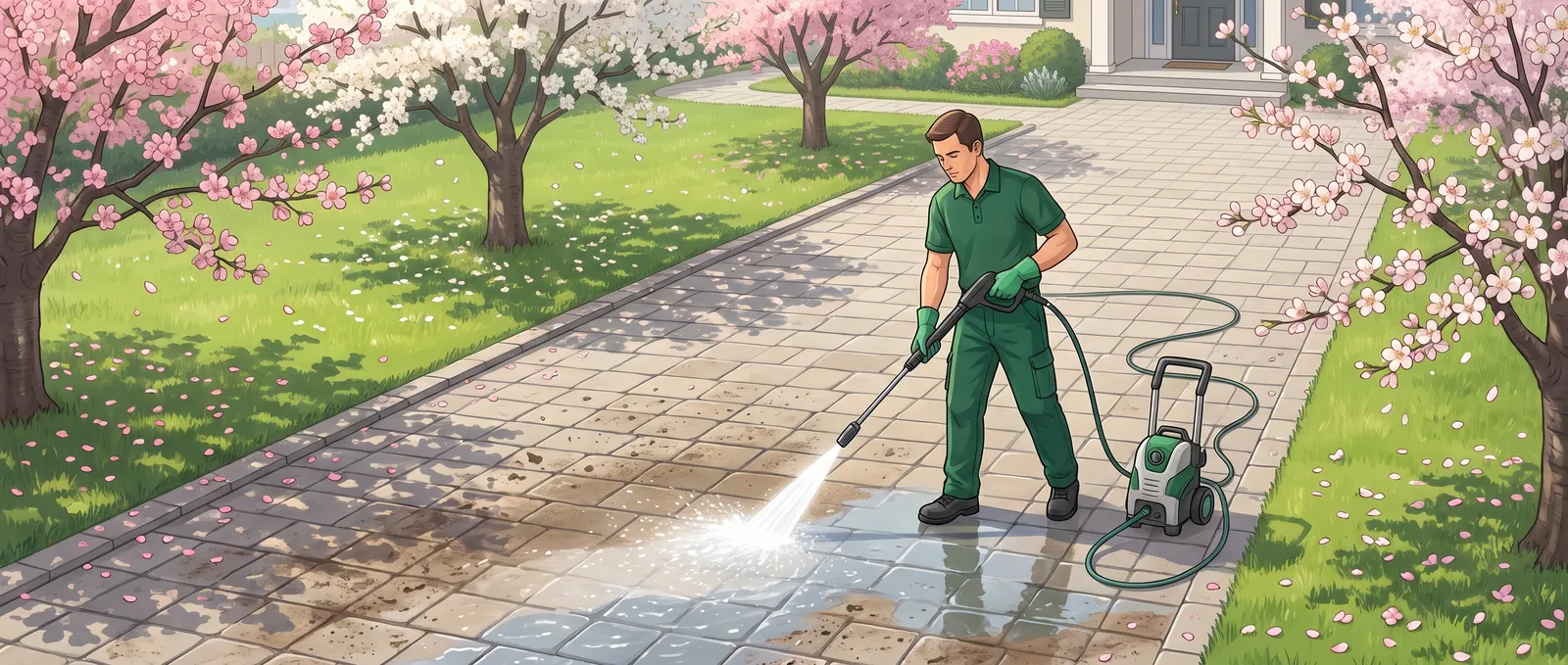
- A pressure washer removes dirt, moss and deposits, but too much pressure and a nozzle held too close can wash out the joints and damage the surface of the blocks.
- After washing, the sand in the joints must be topped up – without it the blocks start to shift and weeds come back faster.
- Sealing only makes sense on clean, dry paving, a few days after washing.
- Professional block paving cleaning with MagCleaning costs from 10 zł/m².
Why spring is the time to clean block paving
Winter is the hardest time of year for block paving. Road salt and grit carried in on car tyres and shoes settle into the pores of the concrete, freeze–thaw cycles loosen the joints, and damp and shade encourage moss, algae and lichen. After a few months, a driveway that looked fine in autumn turns grey, a green film appears in the joints and the first weeds sprout along the edges.
Cleaning block paving in spring removes all this dirt before it has a chance to set in. Spring cleaning also makes simple practical sense: a clean surface is less slippery, and any gaps, sunken areas or loose blocks are visible straight away and can be fixed before the season. For businesses, restaurants and housing communities (wspólnoty) it is also about image – the entrance to the building is the first thing a customer or resident sees.
When exactly to clean paving? The weather matters
It is worth waiting until night-time temperatures stop dropping below zero. Water that gets into the joints and pores of the blocks and then freezes can break up the material and push sand out of the joints. Around Warsaw this usually means the second half of spring, but it is better to go by the forecast than by the calendar.
The ideal day is dry, overcast or lightly sunny, without strong wind. In full heat, water with cleaning products evaporates quickly, making even cleaning harder, and in rain it is hard to judge the result and top up the sand in the joints. Also plan a few dry days after washing if you want to seal the surface afterwards.
- no night frosts in the forecast for the following days
- a dry surface and no rain on the day of cleaning
- moderate temperature, without full midday sun
- access to water and electricity on site
- a few dry days after cleaning, if you plan to seal
How to clean block paving step by step
The question of how to clean block paving comes down to the order of work. Skipping a stage usually means that after a few weeks the surface looks bad again – or, worse, starts to sink.
1. Sweeping and removing loose debris. Leaves, winter grit, twigs and litter need to be removed before washing, otherwise pressurised water will scatter them across the whole area and block the drains.
2. Removing weeds and moss from the joints. Larger plants are best pulled out by the roots or scraped out with a joint scraper. A pressure washer will deal with moss and algae, but weed roots often stay deeper down.
3. Applying a cleaning product. On heavily soiled paving, especially with a green film, products for concrete and stone are used. The product is applied to a wetted surface, left for the time recommended by the manufacturer and not allowed to dry.
4. Pressure washing. The water is directed at an angle, not perpendicular to the blocks, moving the lance in even strips. A rotary surface cleaner attachment for flat surfaces works best: it cleans evenly and limits dirt splashing onto the façade and plants.
5. Rinsing and filling the joints. Once the paving is dry, dry sand needs to be poured into the joints and swept across the whole surface until the gaps are filled. This stage is often skipped, but it is key to the stability of the surface.
Pressure washer – how not to damage your paving
A pressure washer is the most effective tool for cleaning paving, but it is also the easiest way to damage something. A jet that is too narrow and a nozzle held a few centimetres from the surface can wash sand out of the joints, gouge marks into concrete blocks and strip their coloured top layer. The damage is often only visible once dry, as lighter stripes and streaks.
That is why you start with lower pressure and a greater distance, checking the result on an inconspicuous patch, and only then adjust the settings. New concrete paving is treated differently from old, porous paving, and natural stone – granite or sandstone – differently again. With natural stone you also need to be careful with chemicals, as some acidic products can discolour it.
A few rules for working safely with a pressure washer: don’t aim the jet along the joints, don’t hold it in one spot – keep the lance moving steadily, protect plants, windows, doors and cars from splashes, and near a façade direct the jet away from the building, not towards it.
Moss, weeds, oil and rust stains
Not every stain on paving comes off with water alone. The table below shows typical problems and how they are usually tackled. Always test a product on a small patch and follow the manufacturer’s instructions.
| Type of dirt | Typical solution | Notes |
|---|---|---|
| Moss and algae | Biological growth remover, then pressure washing | Comes back faster in shade and where drainage is poor |
| Weeds in joints | Removed mechanically with the roots, sand topped up | Washing alone removes the leaves, but roots may remain |
| Oil and grease stains | Degreaser for concrete, applied several times | Old stains may only fade, not disappear completely |
| Rust | Special rust remover for concrete, with care on stone | Remove the source – metal planters, garden furniture |
| Chewing gum | Scraped off mechanically, sometimes softened with hot water | A common problem at shop and office building entrances |
| Bird droppings | Soaking and washing with a disinfectant | For large amounts – a specialist service |
| Efflorescence | Efflorescence removers on new paving | On new paving it often disappears by itself over time |
Filling the joints after washing – the stage that is easy to forget
The sand in the joints is not an extra; it is part of the structure of the paving. It locks the blocks together and spreads loads, for example from a passing car. Pressure washing always washes out some of the sand, and if the gaps are left empty, the blocks start to move, rock and shift. Empty joints are also an ideal place for weed seeds.
Joints are filled with dry, washed fine sand, poured onto the dry surface and spread with a brush until the gaps are completely full. Sometimes this needs repeating after a few days, once the sand has settled. There are also special sands and jointing compounds that inhibit plant growth – it is worth asking about them at a builders’ merchant, especially for driveways in shady spots.
Sealing block paving – is it worth it and when
Sealing block paving means coating the surface with a product that soaks into the pores of the concrete or forms a thin protective layer on it. A well-chosen sealer reduces the absorption of water, oil and dirt, slows the growth of moss and algae, and some products also refresh the colour of the blocks. This makes the next clean easier and means it doesn’t need to be done as often.
The most important rule: sealer is applied only to clean, dry paving. If it is applied over dirt or moss, it will simply preserve them. That is why, after washing, you need to wait a few dry days until the water has evaporated from the pores and joints, and the joints should already be filled. The product is usually applied with a roller or sprayer, evenly, without puddles, on a fine day with no rain forecast.
Sealers differ in purpose: some are for driveways that cars drive over, others for terraces and paths, and others still for natural stone. Before buying, check that the product doesn’t make the surface slippery – this matters on steps and building entrances.
DIY or a company? A comparison
A small driveway in front of a house can be cleaned yourself if you have a pressure washer and the time. Larger areas – car parks in front of a shop, plazas in front of an office building, pavements on housing estates – take many hours of work, often need more powerful equipment, a cordoned-off area and work outside opening hours.
| DIY | Company | |
|---|---|---|
| Equipment | Home pressure washer, brushes | Professional pressure washers with flat-surface attachments |
| Capacity | Good for small areas | Large plazas, car parks, housing estate grounds |
| Risk of damage | Higher without experience of the settings | Pressure matched to the type of surface |
| Cleaning products | Available in shops, you choose | Chosen to suit the dirt and the material |
| Time | Usually a whole day or weekend | A date agreed with you, including outside the building’s opening hours |
| Cost | Equipment, products, water, your time | From 10 zł/m² for block paving cleaning |
Block paving cleaning for businesses, shops and housing communities
For commercial properties, clean paving is about more than looks. The area in front of the entrance, the car park and pavements are the company’s calling card, and a slippery film of moss or oil stains can be dangerous for customers and staff. Cleaning areas like these is usually planned so as not to block traffic – in the evening, at the weekend or in stages.
That was the case with one of the restaurants in Wilanów. The owner wrote: “They cleaned the block paving in front of the entrance and the car park. It looks like new. The only downside: the work took more than one day.” For large areas we always say up front how many days the work may take, so it can be planned.
For housing communities and property managers, paving cleaning goes well with spring outdoor area cleaning and grounds maintenance – mowing, weeding and tidying flower beds.
Block paving cleaning – prices in Warsaw
At MagCleaning, block paving cleaning costs from 10 zł/m², granite and natural stone cleaning from 12 zł/m², terraces from 12 zł/m², and balconies from 150 zł. Weed removal costs from 5 zł/m², and removing pigeon droppings from 20 zł/m². These are indicative prices – we give an exact quote after seeing photos or a free site visit, because the cost depends on the condition of the surface, the type of dirt and access to water.
We work in Warsaw and the surrounding area within a radius of about 20–30 km. You will find details of the service on the pressure washing page, and other rates in the price list. Call or message us on WhatsApp: +48 881 331 880 – during working hours we call back within 15 minutes.
We will clean the block paving in front of your house, shop or office building – from 10 zł/m². Send us photos or book a free site visit, and during working hours we will call you back within 15 minutes.
Pressure washing →Questions and answers
When is the best time to clean block paving?
Does a pressure washer damage block paving?
How do you remove moss from block paving?
How long should you wait to seal paving after washing?
How often should block paving be cleaned?
How much does block paving cleaning cost?
Quote in 1 minute
Choose your premises, answer a few questions and see an estimated price. No sign-up, no obligation.
- 01You answer a few questionsProperty type, floor area or rooms, frequency, date.
- 02You see an estimated priceStraight away on screen, no waiting for an email.
- 03We call back within 15 minutesWe arrange a site visit and send you a written offer.
Would you rather talk straight away? +48 881 331 880 · WhatsApp
Cleaning a sofa at home: a step-by-step guide
You can freshen up a sofa yourself if you know what fabric it is made of and how much water it can take. We explain how to clean a sofa at h…
Stairwell cleaning in a housing community – scope, schedule and contract
A clean stairwell is one of the first things residents judge the board and property manager by. We explain how often to clean a stairwell, w…
Describe your premises and we’ll work out the price
We call back within 15 minutes during working hours. Site visits and quotes for larger premises are free.