
How to choose an office cleaning company – 10 questions worth asking
A good cleaning company is one you stop thinking about after a few weeks, because the office is simply clean. Before you get there, you have to choose well. We have put together the questions that help you weed out random offers, and we explain what to look for in a contract with a cleaning company.
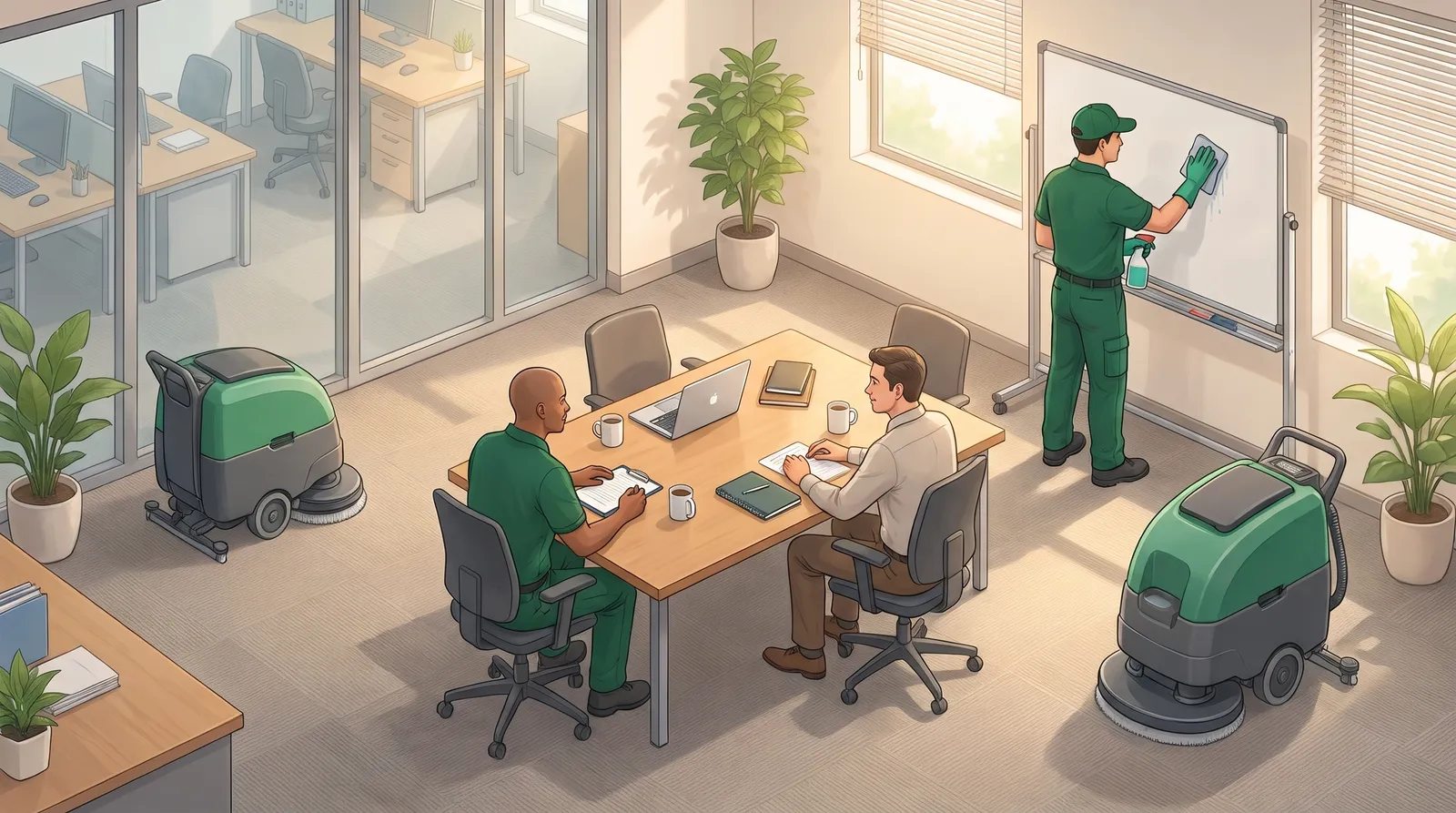
- Start by describing your own needs: floor area, number of toilets and kitchens, frequency, cleaning hours.
- Compare offers by scope of work, not just the rate per m² – a cheap offer with a cut-down scope ends up costing more.
- Check the basics: company registration details, invoices, third-party liability insurance, a regular team and one contact person.
- A good company wants to see the premises before quoting and offers a trial clean.
- In your contract with a cleaning company, set out the scope, the schedule, how to raise issues and the notice period.
Before you start looking: describe what you need
The most common mistake when choosing a cleaning company is sending an enquiry like “how much to clean a 300 m² office?”. Every company will answer differently, because each will assume a different scope. You then end up comparing numbers that don’t refer to the same service at all.
Before you call the first contractor, spend a quarter of an hour writing a short description of your office. It makes the offers comparable and the conversation with the sales rep much shorter.
Add a few photos to the description: the kitchen, a toilet, a typical room and a corridor. The contractor will immediately see the floor types, amount of glass and how much furniture there is, and you will get a quote closer to reality. If your office is in Warsaw or nearby, you can send us these photos via WhatsApp or email.
- Floor area and layout: open space, private offices, conference rooms, reception, floors.
- Number of toilets, kitchens and kitchenettes.
- Floor types: carpet, laminate, tiles, stone.
- Number of people working there day to day and the level of visitor traffic.
- Expected frequency: daily, 3×, 2× or 1× a week.
- Hours when the crew can work: early morning before work, evening, night, weekend.
- Extra services: window cleaning, carpet and chair cleaning, restocking hygiene supplies.
- Access arrangements: keys, cards, alarm, building security.
How to choose a cleaning company: 10 questions for the contractor
The questions below help you quickly judge whether you are dealing with a company that genuinely serves offices or a “does-everything” contractor. The point is not to interrogate the sales rep, but to see whether the answers are specific.
1. Will you come and see the office before quoting?
For larger premises, this is question number one. A company that quotes for a 500 m² office without a site visit either builds in a very wide margin or cuts the scope after the contract is signed. A site visit is usually short, and it lets you establish the real working time, the size of the crew and the equipment needed. With us, the site visit and quote for larger premises are free. For smaller offices, photos and an accurate description are often enough.
2. What exactly is included in the price, and what costs extra?
Ask for the scope as a list, ideally split into daily, weekly and periodic tasks. Ask directly about cleaning products, bin bags, toilet paper and soap, washing up, cleaning the fridge, window cleaning. If the scope is described in a single sentence like “complete office cleaning”, ask for more. You will find a ready-made checklist for comparisons in our article on the scope of office cleaning.
3. Do you issue invoices and how does billing work?
For a business, this is the basics. With a regular contract, monthly billing is convenient – one invoice for the whole month, with the same amount or with any extra jobs itemised. Also check whether the company operates as a limited company or a registered business, and compare its details with the official register (NIP tax number, registered address).
4. Do you have third-party liability insurance?
During cleaning, a leak, a broken pane or a scratched worktop can happen. Third-party liability insurance then protects both sides. Always ask about it, and for larger premises ask for confirmation of the policy.
5. Who will be cleaning my office?
Ideally, a regular contract means a regular team. The people know the office, know which desks must not be touched, where the spare paper is kept and how to switch off the alarm. Rotating staff are the most common reason for quality dropping after a few weeks. Also ask who covers when someone is on holiday or off sick.
6. Who is my contact person and how quickly do you respond?
When something is wrong, you want to call one person, not hunt for whoever is responsible for your premises. Ask about the response time to a report. Our rule is simple: one contact person and a call back within 15 minutes during working hours.
7. What hours can you clean?
Cleaning during working hours distracts people and is less thorough, because it is hard to mop under a desk someone is sitting at. A good company fits the schedule around you: evenings, nights, early mornings, weekends. What matters is that these hours are written into the contract.
8. What equipment and products do you use?
For an office, filtered vacuum cleaners, flat mops and colour-coded microfibre cloths (different ones for toilets, kitchens and desks) are usually enough. For large areas a scrubber is useful, and for carpets an extractor. Ask whether the company has its own equipment and products, and whether it can use yours if, for example, you require eco-friendly products.
It is also a good sign if the company asks you about the materials in your office: types of worktops, floors, screens and furniture. Laminate worktops need a different product from stone or oiled wood. A contractor who doesn’t ask will most likely use one all-purpose liquid for everything – and after a few months that shows in dulled surfaces and streaks on glass.
9. Is a trial clean possible?
A trial clean is the simplest test. After one visit you can see how the crew works, whether it sticks to the scope and how it leaves the office. For companies switching contractor after a bad experience, it is often a condition for starting talks. We offer a trial clean to companies considering a regular contract.
10. How do quality control and raising issues work?
Ask how you make a complaint (phone, email, messaging app), how quickly the company fixes shortcomings and whether it carries out regular checks. Good practice is a walk-through after the first clean and a short conversation after the first month to fine-tune the scope.
What to look for in a cleaning company’s offer
Once you have two or three offers, compare them in a table. The rate per m² is just one row. The comparison below shows how a solid offer differs from one that may cause problems.
| Element of the offer | Good sign | Warning sign |
|---|---|---|
| Quote | after a site visit or based on photos and a description | one rate “for everything” over the phone |
| Scope | a list of tasks with frequencies | one general sentence |
| Price | a “from” rate with an explanation of what affects it | a very low rate with no details |
| Documents | invoice, contract, liability insurance | “cheaper without an invoice” |
| Staff | a regular team under contract | no answer about who will come |
| Contact | one person, a defined response time | a general number with no one responsible |
| Start | a trial clean or a walk-through after the first visit | a long contract straight away with no way out |
A contract with a cleaning company – what it should include
The contract doesn’t have to be long, but it should clear up doubts before they arise. Most disputes come not from bad faith but from different ideas of what “clean” means. That is why it is worth attaching the scope of work as an annex with a list of tasks.
For an ongoing arrangement, check that the contract includes the following:
- Scope of work split by frequency (daily, weekly, monthly, quarterly).
- Schedule: days and times of visits, rules for changing dates, work on public holidays.
- Fees and billing: monthly amount, prices for extra work, invoice payment terms.
- Access to the premises: keys, cards, alarm codes, responsibility for keeping them safe.
- Cleaning products and supplies: who buys them and who restocks paper, soap and bags.
- Raising issues: channel, response time, how fixes are made.
- Insurance and liability for damage.
- Contract term and notice period – reasonable, so both sides can part ways without drama if the arrangement doesn’t work.
Price vs quality: what a good cleaning company should cost
An offer that is too cheap usually means one of three things: less working time than the premises need, staff rotation or skipping part of the scope. For reference: with us, regular office cleaning costs from 2.50 zł/m² per month for visits Mon–Fri, and proportionally less for less frequent cleaning. We show detailed calculations for different floor areas in the article how much does office cleaning cost, and you can check an indicative amount for your office in the calculator.
It is also worth looking at what you get beyond the cleaning itself. One company that takes care of the office, the windows, carpet cleaning and, if needed, small repairs by a handyman means one quote, one invoice and one phone call instead of three.
The most common mistakes when choosing a cleaning company
Most failed arrangements can be predicted at the selection stage. Below are the situations we see most often when companies come to us after changing contractor.
- Choosing on the lowest rate alone – after a few weeks it turns out the crew has too little time for the premises and skips the toilets or kitchen.
- No annex with the scope of work – each side understands “office cleaning” differently, and the dispute is over things like cleaning the fridge or wiping windowsills.
- A schedule agreed “by word of mouth” – the crew comes during the team’s working hours because nobody wrote down that it should be after 18:00.
- No one responsible on your side – several people raise issues at once, often contradicting each other. Appoint one person to deal with the company.
- Forgetting periodic work – nobody planned window or carpet cleaning, so after a year the office looks neglected despite regular cleaning.
- A contract that is too long with no trial period – if something doesn’t work, it is hard to back out. It is better to start with a trial clean and a reasonable notice period.
How to check a cleaning company before signing a contract
Apart from talking to the sales rep, take a few simple steps. Look the company up in the public registers using its NIP tax number. Read client reviews – ideally ones that describe a specific situation, not just praise. See whether the company shows its completed jobs. Notice how quickly and specifically it answers your first enquiry – that usually predicts well how communication will go during the contract.
We have collected our clients’ reviews on the reviews page. One of them sums up nicely what it is all about: “They regularly clean our warehouse and the office next to it. An invoice every month, a regular team, clear rules. That’s how it should be.” – logistics manager from Białołęka.
How starting to work with MagCleaning looks
We have been working in Warsaw and the surrounding area since 2022. The process is simple: you get in touch, we quote based on photos or a free site visit, we agree the date and hours, and then we do the work and a joint walk-through. Regular contracts have a regular team, we bill monthly by invoice, we have third-party liability insurance, and with a new contract we offer up to 20% off the first month. You will find more about our offer on the office cleaning page and under for business.
See how we work in practice: request a free quote or a trial clean. We will call you back within 15 minutes during working hours, and you can work out an indicative price straight away in the calculator. With a new contract – up to 20% off the first month.
Office cleaning →Questions and answers
What should I look for when choosing an office cleaning company?
What should a contract with a cleaning company include?
Is a trial clean worth it?
How many offers should I compare?
Can a cleaning company work outside office hours?
Quote in 1 minute
Choose your premises, answer a few questions and see an estimated price. No sign-up, no obligation.
- 01You answer a few questionsProperty type, floor area or rooms, frequency, date.
- 02You see an estimated priceStraight away on screen, no waiting for an email.
- 03We call back within 15 minutesWe arrange a site visit and send you a written offer.
Would you rather talk straight away? +48 881 331 880 · WhatsApp

How much does office cleaning cost in 2026? Prices per m² and examples
The monthly cost of a cleaning company depends mainly on floor area, visit frequency and scope of work. We show how we calculate the price o…
Office cleaning scope – task list and schedule
“Office cleaning” means something different to every company. To avoid misunderstandings, it is worth breaking the scope down into specific …

Office cleanliness and employee health
Shared keyboards, door handles, the coffee machine and the kitchen make it easy for germs to pass from hand to hand in an office. We show wh…
Describe your premises and we’ll work out the price
We call back within 15 minutes during working hours. Site visits and quotes for larger premises are free.